Wednesday, August 6, 2008

Brookside Gardens 7/18/08

My good friend Scott and his son accompanied me to Brookside Gardens in Wheaton, MD on July 18. The gardens are lush and attract quite a number of butterflies (Click for shots).


Fiery Skipper

Peck's Skipper

Sachem Atalopedes campestris

This is a strongly-marked female. I saw no males on this day, but I have plenty in my garden!


Pipevine Swallowtail Battus philenor

This was a shy individual. Since I've been seeing Pipevines all over the place this year, it's unclear whether he is a native or a releasee from the butterfly house inside.


Eastern Tiger Swallowtail Papilio glaucus

I had fun taking shots of this female from about 50 yards away at the full 420mm extension of my camera's lens.


A much more cooperative male


A Silver Spotted Skipper Epargyreus clarus


An unknown beetle Coleoptera


But the main attraction is the indoor butterfly house that contains a mix of native, Central American, and Asian species. Some I could identify (hat tip: Sarah McVey's website has beautiful pictures and gave me a lot of solid leads on the IDs); others, not. If anyone has IDs for these, I would be grateful.

Nymphalids: Limenitidinae

The Common Sergeant Athyma perius

This Admiral relative looks very similar to species of the genus Neptis.


Nymphalids: Heliconiini

Zebra Longwing Heliconius charitonius

The light dusting on these individuals and the Sara Longwings that follow is pollen rather than a camera artifact.


Sara Longwing Heliconius sara


Postman Heliconius erato or H. melpomene
H. erato and H. melpomene are co-mimetic, and I have no idea which this is.


Tiger Longwing Heliconius ismenius


Isabella's Longwing Eueides isabella

After some debate, this appears to be an Isabella rather than a Tiger. What clenches it is the horizontal band across the middle of the forewing; this is broken in the Tiger but continuous in the Isabella, as here.


Banded Longwing Dryadula phaetusa


Unknown longwing


Nymphalids: Junonia


Chocolate Pansy Junonia iphita


Lemon Pansy Junonia lemonias


The Buckeye, Junonia coenia was here also, but I took no shots.

Nymphalids: Morphos and Owl Butterflies

Morpho helenor


Two images of the same individual with different lighting


Caligo sp.


Misc. Nymphalids

The White Peacock Anartia jatrophae


Clippers Parthenos sylvia
Two different subspecies are featured here:

P. sylvia lilacinus


P. sylvia philippensis


The Question Mark Polygonia interrogationis


Silver Checkerspot Chlosyne nycteis


Lacewing Cethosia sp.


Pointed Leafwing Fountinea eurypyle?


Unknown Nymphalid 1


Unknown Nymphalid 2


Doleschallia sp.?


Crimson Patch Chlosyne janais janais


Paper Kite Butterfly Idea leuconoe


Swallowtails Papilionidae


Variable Cattleheart Parides erithalion polyzelus


Xuthus Swallowtail Papilio xuthus


Great Mormon Swallowtail Papilio memnon agenor. This is a female; the species is substantially dimorphic.


Tailed Jay Graphium Agamemnon


Pipevine Swallowtail Battus philenor. These butterflies, native to MD, are bred in captivity, and it is unclear whether they remain in the house or are released into the wild. The former option is more likely, since bred butterflies might be disease vectors.


Hairstreaks Lycaenidae

Atala Eumaeus atala


Atlas moths!

The Atlas Moth Attacus atlas. My parents gave me a framed pair of these for my 12th birthday. It was an inspiration; how much more inspiring are these live ones!

The moths are sexed by the clear windows on the forewing. The female's window is large, with the point digging directly into the margin. These two are females.


Mating pair. The male is in the foreground, with its forewing window at a somewhat oblique angle to the margin.


JRC Read more...

Monday, July 28, 2008

Peck's Skipper Polites peckius

Peck's Skipper is a somewhat common sight in Maryland, found mid-July every year. This individual was taken on July 18, 2008 at Brookside Gardens.


Shots below showing the class Peck's Skipper pattern. The lighter marks below can vary among individuals.


Above, the stigma is visible.


Several anatomical features can be seen here. The proboscis is double-barreled. The tip of the antenna is two-toned (orange above, darker brown below) and shows the hooked apiculus characteristic of (almost) all skippers. Additionally, the tibia on the legs have two spikes each.


JRC
Read more...

The Fiery Skipper Hylephila phyleus

The Fiery Skipper is a grass skipper common in the South, less so in Maryland. This particular individual was taken on July 18 at Brookside Gardens in Wheaton, MD.


The underside is distinctive, resembling few other grass skippers (compare to The Whirlabout)


Above, the orange color intrudes into the marginal brown bands on both the fore- and hindwing, resembling tongues of flame (hence the name "Fiery Skipper"). The black stigma that runs from the base of the wing to the cell indicates that this is a male. It releases pheromones that help the female find a suitable mate.


The view of the genitalia confirms that this is a male -- note the claspers.


Don't the faces look friendly? The white circle around the eyes is noticeable here.


One more artistic shot.


JRC
Read more...

Saturday, July 19, 2008

Allegany Co. Count 7/11/08

This was my first foray into Allegany County, home to the uncommon and beautiful Northern Metalmark. As with Carroll County, the numbers were low, but a couple of unusual butterflies were sighted.


Count Results (from Bob Ringler): Click for Count Results

Not Tabulated Yet


Highlights

The show-stealer was the Northern Metalmark. These gorgeous creatures are two-toned. The dorsal side is dark brown with two thin metallic bands on margin and post-median. The ventral side is maple-colored with the same bands. The result is a butterfly that flashes two colors in flight. Flight, now, is rare with these. The Northern Metalmark is unquestionably the most sedentary butterfly I've seen. In fact, spotting them was a matter of looking for them on their choice nectar plants: Butterfly weed, a smallish species of sunflower, and goldenrod.

Northern Metalmark Calephelis borealis


The eyes are a striking steel-gray. This flower resembles New Jersey Tea, but I don't know what it is.


Below, the silvery bands are visible against the mapley-orange color.


Another treat was the Aphrodite Fritillary. This butterfly differs from the Great Spangled only in the hindwing below: the Great-Spangled has a cream band in the post-margin that the Aphrodite lacks. The result is that the Aphrodite appears more starkly silvered than the Great Spangled.
The Great Spangled shown in the two pics below was confused. He kept following the Aphrodite in an apparent attempt at mating. He was unsuccesful, but he did manage to provide an excellent comparison specimen!

Aphrodite Speyeria aphrodite
The Great Spangled is in the background. In the hindwing submargin, he has the cream-colored band, partially chewed on this side, that is lacking in the Aphrodite.


The lack of the cream hindwing band combined with the chocolate color of this individual (more typical of the female) brings out the silvery spots quite nicely.


To our great delight, a Zebra Swallowtail popped out of nowhere and sampled the Dogbane long enough for a photo shoot.

Zebra Swallowtail Eurytides marcellus
Photobucket

Photobucket

A Northern Pearly Eye almost escaped detection against the bark of the tree here.


Northern Pearly Eye Enodia anthedonPhotobucket

Roadside and Delaware Skippers joined the usual suspects (Silver-Spot, Dun, etc.) this year.

Roadside Skipper Amblyscirtes vialis on Birdsfoot Ticktrefoil
Photobucket

Delware Skipper Anatrytone logan below
Photobucket

Delaware Skipper above
Photobucket

We had a lone tattered representative of the first brood of Silvery Checkerspots.

Silvery Checkerspot Chlosyne nycteis
Photobucket

Other Shots

Little Glassywing Pompeius verna
Photobucket

Pipevine Swallowtail Battus philenor
Photobucket

Photobucket

Banded Hairstreak Satyrium calanus
Photobucket

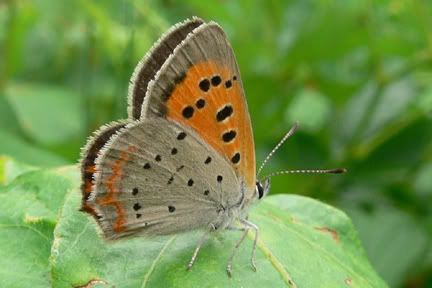
American Copper Lycaena phlaeus
Photobucket

Buckeye Precis (Junonia) coenia. Surprisingly, not common in Allegany Co.!
Photobucket

Northern Broken Dash Wallengrenia egeremet
Photobucket

Monarda with 9 Silver-Spot Skippers (Epargyreus clarus) on it!
Photobucket

Grey Hairstreak Strymon melinus
Photobucket

JRC

Read more...