Sunday, May 25, 2008

Audrey Carroll Audubon Sanctuary

I had a delightful butterfly walk through the Audubon sanctuary in Carroll Co.

Count:

3 Eastern Tailed Blues (Everes comyntas)
1 Azure (Celastrina sp.)
15 Cabbage Whites (Pieris rapae)
4 Orange Sulfurs (Colias eurytheme), including one white-form female
11 Pearl Crescents (Phyciodes tharos)
4 Red-banded Hairstreaks (Calycopis cecrops) -- a time-of-year record for me here.
click for shots


Photobucket

The lighting here was dim, but this shot captures the hairstreak in characteristic behavior: rubbing the hindwings together. A peek of the brilliant blue hindwing top is just visible.

Photobucket

3 Silver-Spotted Skippers (Epargyreus clarus)
click for shot

Photobucket

1 Zabulon Skipper (Poanes zabulon)
click for shots

Photobucket

My wife's favorite: the "Jet Plane" pose
Photobucket

2 Spicebush Swallowtails (Papilio troilus)
1 Black Swallowtail (Papilio polyxenes)
1 Tiger Swallowtail (Papilio glaucus)

JRC Read more...

Monday, May 19, 2008

The Church in Frame's Frame, Part IV

Previous Parts: Part I Part II Part III

What follows is the Tri-Perspectival Model employed in critique of two other models, the Dispensational and Federal Vision models. The purpose of this critique is not so much to bash adherents of either, as if "my model works better than yours." Rather, the purpose is two-fold: to provide illustrations of the utility of multiple perspectives, and to provide a possible rapprochement between Federal Vision adherents and opponents.


A Critique of the Dispensationalist Model

A tri-perspectival view of the Church allows for easy analysis of the dispensational model of the church. On the dispensational account, the true Church is the invisible church, and the visible church is a mere human institution that lacks genuine sanction by God. In fact, for John Darby, the visible church as it is now is a corruption and an exaltation of a human institution to replace God's pure bride1. He laid the apostasy of the Church of England at the feet of the visible church and the practice of infant baptism in particular -- that the Church of England mistakenly believed that God actually did something through the sacraments2. Only at the beginning of the "gospel age" was the visible church the actual Church of God3, but it quickly apostasized because it was built by men rather than God.

Progressive dispensationalism has softened Darby's view considerably. No longer is the visible church a corrupt structure that pretends to be God's true church. Rather, the visible church is seen as "a present reality of the coming eschatological kingdom." 4. This is clearly a positive development!

Nevertheless, the various dispensational models so emphasize the existential perspective that the normative perspective completely recedes into the background. As a result, the visible church is despised instead of honored. The "family", covenantal nature of the church is denied entirely, and church membership is downplayed or omitted entirely.

As a result, the dispensational church is unable to practice robust church discipline. What does it mean to excommunicate someone from a dispensational church? Nothing at all; he has the perfect freedom to go down the road to the next church.

Further, the dispensational church is unable to make anything of the federal holiness of children of believers. It's not that 1 Cor 7 is explicitly denied; rather, it has no force in the practical theology of dispensational churches.

All of these unfortunate features come about by a distortion of perspectives: an overemphasis on the existential; an underemphasis of the normative.

A Critique of the Federal Vision

In many ways, the Federal Vision's5 view of the church represents a polar opposite from the dispensational view. In the Federal Vision, the Church on this side of eternity is visible only:

The Church

We affirm that membership in the one true Christian Church is visible and objective, and is the possession of everyone who has been baptized in the triune name and who has not been excommunicated by a lawful disciplinary action of the Church. We affirm one holy, catholic and apostolic church, the house and family of God, outside of which there is no ordinary possibility of salvation. In establishing the Church, God has fulfilled His promise to Abraham and established the Regeneration of all things. God has established this Regeneration through Christ—in Him we have the renewal of life in the fulness of life in the new age of the kingdom of God. We deny that membership in the Christian Church in history is an infallible indicator or
guarantee of final salvation. Those who are faithless to their baptismal obligations incur a stricter judgment because of it.

The Visible and Invisible Church

We affirm that there is only one true Church, and that this Church can legitimately be considered under various descriptions, including the aspects of visible and invisible. We further affirm that the visible Church is the true Church of Christ, and not an “approximate” Church. We deny that such a distinction excludes other helpful distinctions, such as the historical church and eschatological church. The historical Church generally corresponds to the visible Church—all those who profess the true religion, together with their children and the eschatological Church should be understood as the full number of God’s chosen as they will be seen on the day of resurrection.
6


For the FV, the "invisible church" is an eschatological category (it is commonplace to push the language of WCoF 25.1 to mean that "invisible church" at any moment in time consists of all people who ever will be saved, even if they are currently not saved or even not yet born), while the church in this age is the visible church. Importantly, the visible church on the FV account is not "approximate" but rather the genuine family of God.

If we see the FV account of the Church in contrast to the dispensational, a salutary feature appears: the Federal Vision wishes to restore to the Visible Church a sense of proper belonging. Where dispensationalism (which has always exerted a pull in Presbyterian circles, even after official denunciation) despised the normative perspective, the Federal Vision restored the normative perspective to a place of honor. So much the good.

However, the emphasis on the normative becomes (in my opinion) so great that it distorts the other perspectives. In particular, the existential perspective is positively disparaged. The FV discourages introspection, emphasizing the unknowability of God's decrees and the fallibility of our own assessments about our own salvation7.

The cost of doing so is that the approximate nature of the normative perspective becomes denied entirely: "We further affirm that the visible Church is the true Church of Christ and not an approximate Church."

One particular problem is what to make of the Reformation. In 1517, the Visible Church in the west was the Roman church. If we must affirm that the Roman church was "the Church, and not an approximate Church", then it becomes difficult to see how Luther's excommunication bull was anything other than a direct expression of God's rejection of his teachings.

Likewise, as we stand 500 years beyond the Reformation, with Protestantism splintered into hundreds of discernible fragments, identifying the visible church is an approximate business in itself. Do Pentacostal churches count? How about Oneness churches?

In short, the Federal Vision's identification of the Visible Church with the Church of God amounts to an overly optimistic estimate of our knowledge. It conflates without sufficient warrant the Church that we see (and who is indeed authorized to act as God's Church!) with the Church that we cannot see.

Now, the conflation is not total. There is a clear acknowledgment that not all who belong to the church now will be welcomed as members of God's church in the eschaton. But entirely identifying the Visible Church with the present Church and the Invisible, with the eschatological Church has the undesirable side effect of creating confusion about the salvation of the current members of the Church. Are they, or are they not, children of God as mentioned in John 1.12?

It is my opinion that the "covenantally elect" language that caused so much trouble for Steve Wilkins was logically necessitated by the desire to entirely identify the present Visible Church as the present Church of God. One reads in his treatment of Ephesians 1, for example ("The Federal Vision", ch. 2) an insistence that because Paul addresses the Church in Ephesus without distinction, that therefore, Paul is attributing the language of Ephesians 1 to each Church member without distinction, "head for head."

Out of his treatment of such passages then flows the covenantal election schema, since Wilkins (very reasonably!) does not believe that the entirety of the Ephesian church, "head for head" is actually eternally elect. There must be some other kind of election -- and the rest follows.

Well ... the mistake lies at the beginning. Paul's knowledge of the Church is just as approximate as ours. The special apostolic gifts notwithstanding, Paul was not possessed (as far as we know) with any salvation-o-meter that allowed him to single out the elect within the Ephesian church. Nor were they all possessed, "head for head", of such infallible assurance as to be certain of whom he meant.

But rather, Paul speaks to the visible church in Ephesus as an approximate church on two grounds:

First, that the church has a right to be called the body of God (this half corresponds to the "judgment of charity" notion).

Second, that the members themselves are federally holy: they *ought* to be possessors of salvation, even if they are not. (In this limited sense, one could admit the language "covenantally elect", though it seems too confusing for proper use as a term).

In short then, the Federal Vision overcorrects for nascent dispensational tendencies by reading questions about the identity of the Church primarily through the normative lens. The result is a theology that has trouble interfacing with standard readings of the Confession. As recent events have witnessed, and regardless of "who is right" with respect to the Federal Vision controversy, the adherents to the Federal Vision have trouble making the basic case that their theology is "genuinely Reformed."

In my opinion, the central trouble is the predominance of the normative perspective in their teachings (though not expressed in that language!)

These critiques do not imply that other combinations of perspectives represent the "perfect" way of viewing the Church. In general, the normative perspective will have a tendency to over-estimate the Church, including those who do not belong simply because we ought to give supposed brothers the benefit of the doubt.

By contrast, the situational perspective will tend to cut out genuine believers who struggle with besetting sins, while wrongly including hypocrites who know how to act Christianly.

And the existential perspective likewise tends to underestimate those whose consciences trouble them while overestimating the complacent.

Clearly, no combination of the perspectives will allow us perfect ability to peek into the decrees of God and see the Church as He does. But together, these perspectives, each mandated by Scripture, provide us with the best estimate possible of the Church of God.

As a personal appeal, I would ask my Federal Vision brothers to consider whether tri-perspectivalism might satisfy their concerns more fully.

JRC

1. It is on this confusion and error that popery, Puseyism, and the whole high-church system is built. They have not distinguished between the building which Christ builds, where living stones come to a living stone, where all grows to a holy temple in the Lord (that is, where the result is perfect), and that which man avowedly builds, though as God's building, and where man may fail and has failed. I am entirely justified in looking at the outward thing in this world as a building, which in pretension, character, and responsibility is God's building; yet it has been built by man, and built of wood and stubble, so that the work is to be burned up in the day of judgment which is revealed in fire. Yea, more, I may see that corrupters have corrupted it; and that, if any have dealt with it in this character, they will be destroyed. In a word I have a building which Christ builds, a building in which living stones come and are built up as living stones, a building which grows to a holy temple in the Lord. I have also what is called God's building, as that which is for Him and set up by Him on the earth, but which is built instrumentally and responsibly by man, where I may find very bad building and even persons corrupting it. -- JN Darby, The Church -- The House and the Body. This site has the works of Darby, which contain many such quotes.

2. The sacraments or ordinances, for there is a sacramental system, are the earthly administrations of revealed privileges, an outward system of professed faith, and a visible body on earth. Life and membership of Christ are by the Holy Ghost. We are born of the Spirit, and by one Spirit baptized into one body. To say we are members of Christ by baptism is a falsification of the truth of God, by confounding (directly contrary to scripture) the external admission to the earthly profession with life from God; and it is the falsification of the meaning even of the sign. It is the other sacrament, not baptism, which (even externally) exhibits the unity of the body. The Lord's supper is in its nature received in common. The assembly or Church participate. Hence we have (Eph. 4), "one Spirit, one body, one hope of your calling." This belongs to the Spirit and spiritual persons. "One Lord, one faith, one baptism"; such is the outward profession and faith of Christ. The confounding the outward administration by ordinances with the power of the Spirit of God is the source of popery and apostasy. It is pitiable to see how Augustine (a truly godly man personally, who felt what life and the true Church were, when the outward thing had become grossly corrupt) writhes under the effort to conciliate the two -- ibid.

3. J.N. Darby, What is the Church as it was at the Beginning? And What is its Present State?

4. Blaising and Bock, Progressive Dispensationalism, p. 258.

5. A standard disclaimer must be noted here: the Federal Vision is not a monolithic movement. The critique in this article is leveled at the Joint Federal Vision statement; quotations of views of individuals such as Steve Wilkins should not necessarily be imputed to others. That said, certain themes emerge in the writings of self-identified Federal Vision adherents.

6. The Joint Federal Vision Statement.

7. The Federal Vision, pp. 29-32, 56-57. Doug Wilson takes a more nuanced (though still on balance negative) approach to introspection, while Mark Horne wants for children in particular to think of themselves as Christians without having to worry about their unknown state of election.
Read more...

The Church in Frame's Frame, Part III

Previous Parts: Part I Part II

Recap: The Church is complicated because it is the company of God's eternally elect, but it is also a family. When we think of the church as God's bride, we think in terms of purity and personal possession of salvation. The church defined in this way cannot be seen by human eye. But when we think of the church as a family and as the means by which God brings the Gospel to the nations, we are thinking of the Church as it functions in space and time. We therefore have a problem of knowledge as we approach the church: Who properly belongs to it?

This problem cannot be solved by a simple appeal to election. While it is true that God accepts only His children as genuine members of his body into eternity, our lack of "election-o-meters" prevents us from applying election as an operational test for church membership.

Nor can the problem of knowledge be solved by a simple appeal to outward profession of faith. The Scriptures make clear that not all who name Jesus as Lord actually know Him as such.

Further, it appears to be God's plan to leave this tension unresolved on this side of eternity. The parable of the Wheat and Tares suggests that God leaves tares within the church until his appointed time1. And the fact that family members of Christians are considered "holy" -- even if unsaved (1 Cor 7.12-14) eliminates the possibility of defining the church cleanly as "those who possess saving faith."

And yet, the Church is Christ's body; we must affirm that unbelievers do not properly belong to it. It is for this reason that Paul urges the Corinthians to "expel the wicked man from among you."

How then are we to understand the church? Whom should we consider as belonging to the church?

I contend here that the problem of knowing the church only admits of partial solutions viewed from different perspectives2. In the final analysis, we do not have access to God's decrees, and we cannot see the Church as God sees it. What we have instead is several different Scripturally mandated ways of measuring the Church approximately.

If we ask, "To whom do we owe an obligation to treat as a brother in Christ?", we are asking a normative question. The answer to that question describes a set of people whom we may call "the Church"; we are measuring the Church by the yardstick of ethical obligations that naturally exist by virtue of belonging to Christ's family.

Yet we recognize that the members of this set of people do not necessarily possess salvation, so that the Church as measured by ethical obligations does not correspond perfectly to the Church as God sees it. So we might ask a second question: "Who displays the fruit of belonging to Christ?" This fruit might include outward professions of faith as well as visible demonstrations of the fruit of the Spirit. The answer to that question also describes a (different) set of people whom we may call Christians -- Christ's people. We are measuring the Church according to visible observation of their fruit.

And yet again, we recognize that some who have the appearance of Christ's followers can yet be in unbelief, while some who belong to Christ can sin grievously for a time. Thus, the Church as measured by visible observation of fruit still does not correspond perfectly to the Church as God sees it. In particular, many struggle concerning themselves: do I belong to the Church? So each individual must consider a third question, "Do I believe the Gospel and trust in Christ?" Here each man measures himself in relationship to the Church by discerning whether he legitimately belongs to it.

Now two things should be clear from the outset. First, none of these metrics is fool-proof. The Scriptures insist that people can belong to the Church visibly, or display a kind of false fruit of salvation (cf. 1 Cor 13), or imagine themselves to be saved, and yet fail to truly belong to Christ's people (Matt. 7.22).

But second, none of these metrics can be disposed of. Because our view of the Church is limited, it can be tempting to grab on to one of these perspectives as "the way" to see the church. Hence, the Roman Catholics view the Church almost entirely through the normative perspective; modern evangelicals, through the existential. Yet Scripture pushes us to admit that none of these perspectives is so dispositive as to preclude the others.

So our task, then, is to consider three different ways of measuring the Church: a "tri-perspectival" view of the Church. None is sufficient by itself; but each can be found in the Scriptures at various points.
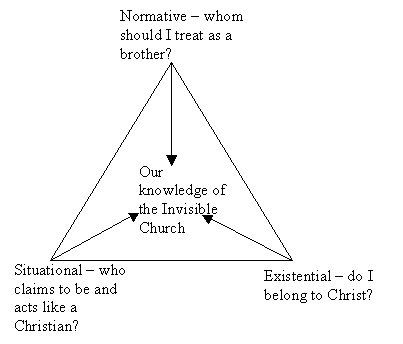
Photobucket

The Normative Perspective

Here we ask the question, "Whom should I treat as a member of the Church?" The Scripture demands this question at several points:

1. Hebrews 13.1 exhorts us to "Keep on loving each other as brothers." And again, Gal. 6.10 tells us to "do good to all people, and especially to those who are of the household of the faith."

Now the question becomes, whom must we treat in this way? That is, as I consider my special obligation to do good to the household of faith, whom should I treat in this way?

And the answer is clearly, those who visibly profess Christ and belong to His Church. From the perspective of my obligations, if only to err on the side of caution, I must treat all who profess Christ as if they are legitimately a part of Christ's people.

In other words, the normative perspective on the Church leads us to define the Church in terms of a visible boundary: visible church membership. No other answer to the question will do. I could not, for example, choose to not love Alice on the grounds that her behavior "proves she is not a Christian"; without the warrant of formal excommunication, such an action amounts to the hand rejecting the foot.

2. Hebrews 13.17 exhorts us, "Obey your leaders and submit to them, for they keep watch over your souls as those who will give an account."

To whom must I submit? To the leaders of my church. Here, the normative perspective leads us again to define the church in terms of its visible leadership. I cannot (unless I leave the church) choose which elders I will submit to and which I will disregard.

3. 1 Cor 7.12-14 asserts that the children of believers are "holy." In what sense? Certainly, all agree that children of believers are not automatically saved, nor automatically sanctified from within. But they are holy, "set apart", in this sense: they have a special obligation above those outside the church to believe and obey the Gospel. To whom more is given, more is required.

They are normatively holy, people who ought to be and have every reason to be Christians even if they are not.

So from the normative perspective, we get a strong sense of the "family" and "government" character of the Church. From this perspective the Church includes some who might not be actually saved: false brethren, false leaders, apostate children. Those people do not have a real right to belong to God's fellowship, and yet God in His providence leaves them in place until such time as He chooses to cut them off.

We, on the other hand, must err on the side of caution with regard to their membership, because we are not wiser than God and because we have no direct knowledge of the salvation of individuals.

The Situational Perspective

We do, however, have the ability to read the actions of professing believers and measure them for two purposes: avoiding false teachers, and exercising church discipline. This perspective is called the "situational" in that it assesses the observable situation. It measures the church according to what we can see.

If we used only the normative perspective to measure the church, we would wrongly allow unbelief to persist within the church. While God's providence is ultimately sufficient to deal with this, He has also commanded us to measure the lives of others in limited ways in order to preserve the purity of the Church.

1. In Matt. 7, Jesus positively commands his followers to avoid false teachers, telling them, "Beware of the false prophets, who come to you in sheep's clothing, but inwardly are ravenous wolves. You will know them by their fruits. Grapes are not gathered from thorn bushes nor figs from thistles, are they? So every good tree bears good fruit, but the bad tree bears bad fruit. A good tree cannot produce bad fruit, nor can a bad tree produce good fruit. Every tree that does not bear good fruit is cut down and thrown into the fire. So then, you will know them by their fruits. Not everyone who says to Me, 'Lord, Lord,' will enter the kingdom of heaven, but he who does the will of My Father who is in heaven will enter. Many will say to Me on that day, 'Lord, Lord, did we not prophesy in Your name, and in Your name cast out demons, and in Your name perform many miracles?' And then I will declare to them, 'I never knew you; depart from me, you who practice lawlessness.' -- Matt. 7.15-23 NASB

2. Likewise, 1 Cor 5 enjoins the church leadership to expel self-named Christians who unrepentantly practice lawlessness.

Here, the situational perspective refines the normative perspective: we owe love to church members and submission to church leaders, but that love and submission are not so absolute that we blindly accept their every action as legitimate.

Thus, we get a sense of how the two perspectives can combine in cases of church discipline: the behavior of the believer is weighed specifically by the church leadership, who are then given the authority to require repentance (on the basis of an individual's church membership) and in extremis to pronounce an individual outside the normative boundary of the church: that is, to excommunicate.

The Existential Perspective

In addition to assessing our ethical obligations to others and to observing the fruit of other believers, the Scriptures also tell us to assess ourselves.

1. As Paul wrestles with the Corinthians concerning their following of false teachers and questioning of his authority, he turns the tables and commands them, "Examine yourselves to see whether you are in the faith" (2 Cor 13.6).


This self-examination brings out what could be called the existential perspective. It asks each individual to assess who he is in relationship to the Church: Do I belong? Do I believe in Christ?

Self-examination is enjoined or implied in various passages. Sometimes, it is more internally focused, as 2 Cor 13.6 above, or as Jesus insinuates to Nicodemus in John 3 ("You are the teacher of Israel, yet you do not understand these things?"). Sometimes, it is externally focused. James 2, for example, brings the reader to the point of self-examination with regard to his own works and their consistency with professed faith.

From this perspective, each individual bears responsibility for knowing whether or not he is a part of the Church.

Interaction between Perspectives

Many of the common functions of church government show interactions between the perspectives. For example, church discipline begins with an assessment of the outward behavior of the individual, with a goal towards self-assessment by the individual (leading hopefully to repentance). In the extreme, that individual may be declared normatively to be outside the Church.

We see in church discipline the various perspectives at work, while recognizing that none of them is a perfect measure of who properly belongs to the church -- saved individuals can be wrongly excommunicated; unsaved individuals can be overlooked by church leadership.

The practice of communion also combines the various perspectives. With whom should we partake communion? With all who belong to the Church visibly. But as we partake, we are also asked to examine ourselves and to reaffirm that we, partaking of the one loaf, also belong to Christ's body.

Likewise, our assurance that we belong to Christ draws on each of these perspectives. Clearly, there is a large existential component here; it may indeed be so strong as to constitute what the Confession calls an "infallible certainty." And yet, we also take comfort from the evidence of the fruit of the Spirit in us (situation) and also from the claim made on us by baptism (normative).

Correspondence with the Confession

Some might wonder how well the tri-perspectival view of the Church corresponds to the picture given in the Westminster Confession, since tri-perspectival language is, superficially, very different from the language of the WCoF.

The three perspectives taken together -- especially the normative -- correspond to the Visible Church of 25.2 and 3. Sections 25.4-5 correspond to the problem of knowledge; we use the practices of any given Church to try to discern whether it is legitimately a part of God's Church.

Ch. 26 ("The Communion of the Saints") corresponds strongly to the normative perspective, while 27-30 (Sacraments and Church Censures) combine all three. The question of Assurance in ch. 18 addresses the existential perspective.

In other words, the tri-perspectival model attempts to reorganize our Confessional approach to the Church without modification (at all!) of the Confessional content.

Why re-organize, then? Most importantly, our tri-perspectival model demonstrates the unity between the Visible and Invisible Church. The two are not separate entities; rather, the Visible Church *is* the Church -- as far as we can see. It has the right to the name of Christ. But also, the Visible Church consists of our perspectives; therefore, it does not have an absolute right to the name of Christ. Its boundary is an imperfect approximation of the boundary of God's elect.

This is entirely in harmony with the Confession. However, it prevents one important misconception. As John Murray noted3, the language of the Confession can sometimes lead some to a wrong belief that the visible and invisible churches are two separate entities. Not so: rather, the Visible Church is our way of knowing the true, Invisible Church of God.

The Bidirectional Nature of the Perspectives

Thus far, we've seen the three perspectives as three legitimate but imperfect ways to reach behind the veil and perceive God's Church. But as it turns out, the three perspectives also correspond to the ways in which God communicates the gospel to the lost.

Normatively, the Church has the authority to preach the Gospel and to declare the boundaries of heresy. In the end, how can we know that those nice Mormons who "believe in Jesus" are nevertheless not Christians? Because they reject the testimony of the Church as expressed in the Nicene Creed -- which in turn rests on good and necessary inference from Scripture.

Situationally, God communicates the gospel through the actions and relationships of its members. "By this", says Jesus in John 13.35, "all men will know that you are my disciples: that you love one another."

Existentially, the work of the Spirit, which normally comes through the preached Word and administered Sacraments, convicts men of sin and their need for repentance.

Thus, the Visible Church is not merely a concept needed to solve our problem of knowledge. It does indeed function in that way, but moreover, the Visible Church is the functioning of God's Church in the here and now.

Thus, we have two ways of thinking about the Visible Church:

(1) The Visible Church is our best view of God's true and Invisible Church, refined by means of the various perspectives.

(2) The Visible Church is the family of God in the here-and-now, authorized to act as God's Church in the proclamation of the Word and the administration of the Sacraments.

JRC

1. Sometimes it is argued that the designation of the field as "the world" in Matt. 13.38 precludes thinking of the Tares as members of the church. But this argument strains at gnats. The point of the parable is that the wheat and tares are indistinguishable until they bear fruit -- which could hardly be the case if the wheat were all within the church and the tares without!
2. Here I will be drawing on the perspectivalism of John Frame. See here and here, as well as Frame's Doctrine of the Knowledge of God.
3. John Murray, Christian Baptism, Chap. 3.
Read more...

Sunday, April 27, 2008

Morgan Run Butterfly Outing 4/26/08

Morgan Run NEA is a reasonable drive from us, so my daughter and I decided to see what spring butterflies were out and about.

We saw 24 Cabbage Whites, 20 Eastern Tailed Blues (1 dark form; the rest blue), 4 Juvenal's Duskywings, 4 Pearl Crescents, and a Tiger Swallowtail.

And acquired 15 dog ticks in one hour. Hikers beware!

Eastern Tailed Blue (Everes comyntas)

Photobucket

This individual, a male based on the dark margins and blue coloration, is taking in salts. He has a wingspan of about 1" or so.

JRC Read more...

Sunday, February 17, 2008

The Church in Frame's Frame, Part II

Part I

The Church is a Family

In the previous post, I argued that the Church is the company of God's eternally elect. But now as we examine the pattern by which God expands his people and thus causes the church to grow, we discover something startling: God's plan from the beginning has been for the Church to grow by means of human families. This fact leads naturally to a tension between the church as we see it and the church as only God can see it: the visible and invisible aspects of the Church.


When God created Adam and Eve, he created them to be the firstborn of a holy race1:

So God created man in his own image,
in the image of God he created him;
male and female he created them.

God blessed them and said to them, "Be fruitful and increase in number; fill the earth and subdue it. Rule over the fish of the sea and the birds of the air and over every living creature that moves on the ground."
-- Gen. 1.27 - 28

We often focus on the ruling nature of man, but sometimes lost is the significance of the juxtaposition of vv. 27 and 28: Adam and Eve were intended to propagate the image of God. Their mandate was to create a people who would have fellowship with their creator.

And of course, this mandate was frustrated by the fall. We see this in the dashed hopes of Eve in Genesis 4, when she begets a son by the help of the Lord (cf. 3.15), and yet her son turns out to be an agent of sin rather than the seed who crushes Satan.

And yet, the vision of a holy race is re-promised in 3.15 with the protoevangelium. It is further articulated in the restatement of the mandate to Noah (9.1 - 3).

Most importantly, the vision of a holy race is explicitly articulated in the covenant God makes with Abraham. God intends to create a people for Himself within Abraham's family. Of course, His purposes are larger still. He intends to bless all the nations through Abraham. Some of the Gentiles (Ruth, Rahab) will be incorporated into the holy race through adoption. But at this stage in the development of the people of God, His primary means of multiplying His worshipers is through the family.

This has some important implications for the descendants of Abraham. First, all of the males receive the sign of purity, the sign of cutting away of the sin nature, the sign of circumcision. More importantly, all of Abraham's descendants are ethically obligated to keep God's commands, and not merely by way of external obedience, but from the heart (Rom 2.28, 29, with reference to such passages as 1 Sam 15.22, Hos. 6.1-6). But also, all of Abraham's descendants have a certain right, though not absolute or inalienable, to participate in the worship of the Lord. In fact, nominally, Israel is a people, a race, set apart and holy to the Lord. We may even speak of them as "historically elect" with the clear understanding that this term means "chosen out of the nations and obligated to be holy" rather than "chosen to be a part of God's remnant."

As Israel moved through her history in the OT, her designation as a holy race came into tension with the designation of God's people as His eternally elect. The simple fact was that many of Abraham's descendants themselves were not eternally elect, beginning with Esau. This fact created a problem not merely for systematic theologians but in the reality of Israel's experience. While Israel was normatively obligated to be holy to the Lord, a significant proportion of Israel -- a majority at times -- were idolaters. This was the burden of the prophetic oracles such as Amos. God's response to this situation was two-fold: first, to promise an eschatological age, a New Covenant, in which the heart would be circumcised; and second, to pursue a program of pruning out the branches that did not properly belong to Israel because of their lack of holiness. We can see this at work in the time of the Judges; in the books of Samuel and Kings; in the Bablyonian captivity; and ultimately in the fall of Jerusalem in AD 70. In all of these, God preserved the remnant that He knew to actually be His, and provided judgments that prefigured the eschaton (cf. Joel) to winnow away those who were not.

Israel's theologians had a hard time understanding the tension between God's election and His means of growth. It was easy for them to mis-read their family descent from Abraham as an actual entrance into relationship with God, or for them to place confidence in the performance of sacrifices In fact, one way of putting the Jew/Gentile problem in the early church is that the Judaizing party had come to mistake the plan of growth through a holy race for election itself. More succinctly, they mistook "historical election" for "eternal election."2

Hence, the emphasis on circumcision: if you wanted to be "chosen by God", you had to become a part of the race. This is of course backwards, and Paul refutes it clearly in Galatians 3. Peter also, in his own way, refutes this thinking in Acts 10. Why are the Gentiles given the sign of cleansing and the outpouring of the Spirit? Because they demonstrate the fruit of God's regenerating work in themselves; they are already a part of the holy race.

With the church, now, the growth plan shifts in emphasis. The full extent of the Abrahamic covenant, that he would be the father of many nations, is now implemented much more through evangelism and the fulfillment of the Great Commission. But this fact does not annul the growth of God's people as a holy race, His work through the family. The Great Commission does not set aside the growth plan. Rather, it merely brings adoption to the fore as a more prominent means of growth.

We see this in part in 1 Cor 7.14, in which the families of believers have been "sanctified." Not made holy in the sense of magically turned into believers by virtue of parentage (cf. Luke 3.8), but sanctified in the same sense that Israel as a whole was sanctified: set apart and obligated to be holy. Children of believers are not themselves automatically believers, but they should be. That is to say, from the perspective of human contingencies, the children of believers have every opportunity and therefore have even less excuse than the pagan for disbelieving the Gospel (cf. Rom. 3.1-2).

We see this further in the commands given to families in Ephesians 5. Husbands, wives, children, and parents are all obligated to act in the Lord towards one another. Noticeably absent is any exemption for children who are unbelievers. Paul gives no qualification that children are to obey their parents in the Lord, unless they happen to not belong to Christ. No, the obligation is laid upon all children with the expectation that "this is right." The ethical obligations enjoined upon Israel are also enjoined upon all who belong to the Church (cf. 1 Cor 5, 6).

Even empirically, we see that God calls people by means of families as well as evangelism. Around the world, historically, Christianity has been a family affair. Given the safe assumption that all whom God has effective called have come to faith, it is worth noting that God has apparently chosen to disproportionately elect children of believers.

And finally, the continuation of the plan to grow a holy race is seen in the language employed to describe God's people. They are "children of God", "brothers of Christ", "brothers of one another", "a holy nation."

So within the Church, as within Israel, God's plan of growth by means of family continues. This plan of growth, along with the very real evangelistic problem of pseudo-faith (cf. Matthew 13), creates the same tension in the Church that was present in Israel: the "Church as we see it" is not the same as "the Church as God sees it."

In the New Covenant, the promised Holy Spirit helps to better define the boundaries of the Church, but He has not (apparently) chosen to make those boundaries crystal clear. Our knowledge of the Church, as with many things, is "through a glass, darkly."

The next post will consider our knowledge of the Church by means of various perspectives.

JRC

1. I am indebted to a conversation with Dave Durant for the particular way of putting this. Also present here are ideas from O. Palmer Robertson and John Murray.
2. It also seems that the schools of the Pharisees mistook remnant theology (the notion that God had chosen a remnant by grace) for covenantal nomism (the notion that their status was "in the covenant" unless they fell away by failing to keep the law).
Read more...

Wednesday, February 13, 2008

The Church in Frame's Frame, Part I

For various reasons, the PCA has recently become embroiled in a debate over this question: What is the Church? Who belongs to it? What can we say about those who are visibly members of our church, yet do not have true, fruitful, and persevering faith?

The questions are a direct result of the tension inherent in the Scriptures between God's eternal decrees to save His people and His visible outworking of those plans. On the one hand, the Church is the set of those who are effectually called by God to salvation. On the other, the way in which God works out His calling, seen especially in the government of the Church and also His special consideration for the family, requires us to honor the boundaries of the Church as we see it.

I will argue that the tension between the decrees and their visible outworking denies us the ability to view God's Church through a single lens. There is no salvation-o-meter by which we may measure "the true Church as God sees it." That leaves us collecting knowledge about the Church by means of various perspectives. The Scriptures speak at times of the Church in terms of our ethical obligations to a visible body; at times, in terms of the fruit that we see in ourselves and others; and at times, in terms of our own knowledge of our faith and participation of the promises of God. These three perspectives cohere together to give us approximate knowledge of the Church of God.


The Church is the Company of the Elect

Most obvious in the Scriptures is that the Church is Jesus' bride for whom He died, the flock for whom He laid down His life. This perspective is brought out clearly in the writings of John (John 10; Rev. 5.9-10; Rev. 21), Paul (Eph. 5.25-27), and Peter (1 Peter 1.1-2). The death of Christ for His people is the basis for their forgiveness of sins (Eph. 1, Rom. 5), enabling them to be God's justified people (Rom. 3). Hence, it is the fulfillment of God's promise to Abraham to "be a God" to his descendants, to Eve that her "seed would crush the head of the serpent", and to Israel concerning the new covenant that would remove the principle of sin and death.

In short, when Scripture speaks to and of the Church, it often speaks of it as "the Church as only God can see it" in all of its glory throughout time, the company of the elect who form together a temple in whom God dwells and is worshiped (Eph. 2).

While this view of the Church is in some sense eternal -- "eschatological" -- it would be a mistake to believe that it is a view only possible or practical at the end of time. Far from it; when Paul writes to the church in Rome, he clearly presents their present experience as an intrusion of the eschatological into their lives. Hence:

What shall we say, then? Shall we go on sinning so that grace may increase? By no means! We died to sin; how can we live in it any longer? Or don't you know that all of us who were baptized into Christ Jesus were baptized into his death? We were therefore buried with him through baptism into death in order that, just as Christ was raised from the dead through the glory of the Father, we too may live a new life.

If we have been united with him like this in his death, we will certainly also be united with him in his resurrection. For we know that our old self was crucified with him so that the body of sin might be done away with, that we should no longer be slaves to sin— because anyone who has died has been freed from sin.
-- Rom 6.1-7


Here, as elsewhere, Paul argues from the Roman Christians' participation in the eschatological new life, resurrection, and freedom from sin to their behavior in the here-and-now. He is speaking to them as if it were a settled issue that they have been granted the salvation that characterizes membership in the people of God. The same kind of language is evident throughout the epistles, both Pauline and catholic (e.g., 1 Pet 1).

In systematic terms, of course, we are talking about nothing more nor less than the invisible church of WCoF 25.1.

Further, it is clear in Scriptures that God considers this Church, the company of the elect, to be "the real Church." That is to say, those who do not believe and are not elect have no real right to be there. Instructive on this point are 1 Cor 5, 2 Cor 6.14-18, and Matt 13.24ff).1

More can be said about this Church as God sees it, the "invisible church." It's probably best to let the Scriptures speak for themselves.

Rom. 1.6-8
Eph. 1.18-23
Eph. 3.4-12
Eph. 5.22-33
Phil. 1.1-11
Col. 1.17-23
1 Tim. 3.15
Heb. 12.18-24

But one necessary point needs to be made in preparation for what follows: Our knowledge of this church is necessarily incomplete. There are those who imagine themselves to be a part of it, and yet are not (Matt. 7.21-23). There are teachers who participate in the fellowship of the saints, yet have no legitimate part in it (Jude, 2 Cor 11.1-15). Conversely, there are those who worry about their salvation and yet definitely belong to Christ (Rev. 2.8-11). This body to which we belong, the Church, looks fuzzy to our eyes.

The next post will examine the visible outworking of God's plan in the Church, and why it is that we must speak of and honor the visible aspect of the Church.

1. John Murray makes this point in "Christian Baptism", ch. 3.
Read more...

Monday, February 11, 2008

The Nature of Saving Faith

Can Faith Be Equated With Faithfulness?

"To believe is to obey." This was the thesis of Pastor Dave's sermon this Sunday. He and his wife had lunch with us afterwards, and it gave an opportunity for talking with him about this very point, which has in God's providence been one of my ruminations over the last couple of weeks.

Dave's sermon, incidentally, developed the point by examining why it is in Luke 9 that Jesus did not meet with Herod despite the fact that Herod seemed eager. Why not? Because disobedience -- cutting off the head of John the Baptist, say -- amounts to a denial of God's truth, amounts to unbelief. Clearly, Herod's eagerness to see Jesus was something other than faith.

Dave didn't mention 1 Cor 10 or Heb 10.26-39 in this context, but such were obviously in the background. To disobey is to deny; hence, to believe is to obey.

This was interesting for me because of recent conversations concerning the nature of saving faith (here , here, and here). Is it legitimate to speak of saving faith as "faithfulness"? Is it legitimate to require that saving faith include obedience as a part of its definition? Is it legitimate to require that saving faith be purely receptive of the grace of God? At the back of these questions are concerns on the one hand about legalism, and concerns on the other about antinomianism.

All of these questions are raised by a pair of recent books, the latest in the ongoing Protestant quest to nail down "saving faith" to the systematic subflooring with nary a bubble. These two are Covenant, Justification, and Pastoral Ministry and A Faith That Is Never Alone. The former is a product primarily of Westminster Seminary West and argues (I am told) for a hard separation between faith and obedience in a definitional sense. The latter is a product primarily of Norm Shepherd and those influenced by him, including many Federal Vision lights. It argues, apparently, that faith must include obedience by definition; that is, that faith is faithfulness.

Both are on my reading list, so the summaries above are second hand. Certainly, this post will not be an attempt to interact with either work!

Rather, I thought merely to blog some preliminary thoughts about faith viewed from two perspectives. From the "black-box", empirical perspective, faith looks like faithfulness. When we open up the box and peer inside, it turns out that faith proper is an instrument that receives God's grace, which leads necessarily to obedience. In other words, the inner workings of faith do not properly include obedience; and yet, living faith is always necessarily obedient.

Think about faith as it is presented in James. Not merely in chapter 2, but in the whole of the epistle, the burden of James is this: if your faith is genuine, then it will be seen in the works of your hands (Jas 1.26, 3.13, 4.4 but also 1.3-4, 1.5-8, passim). Or as I often say to my students, "You don't really know something until you know it in your hands." James says in effect, "You don't really believe something until you believe it with your hands."

The author to the Hebrews presents the contrapositive: that those who disobey are unbelievers. So for instance, he warns

So, as the Holy Spirit says:

"Today, if you hear his voice,
do not harden your hearts
as you did in the rebellion,
during the time of testing in the desert,
where your fathers tested and tried me
and for forty years saw what I did.
That is why I was angry with that generation,
and I said, 'Their hearts are always going astray,
and they have not known my ways.'
So I declared on oath in my anger,
'They shall never enter my rest.' "

See to it, brothers, that none of you has a sinful, unbelieving heart that turns away from the living God. But encourage one another daily, as long as it is called Today, so that none of you may be hardened by sin's deceitfulness. We have come to share in Christ if we hold firmly till the end the confidence we had at first. As has just been said:

"Today, if you hear his voice,
do not harden your hearts
as you did in the rebellion."

Who were they who heard and rebelled? Were they not all those Moses led out of Egypt? And with whom was he angry for forty years? Was it not with those who sinned, whose bodies fell in the desert? And to whom did God swear that they would never enter his rest if not to those who disobeyed? So we see that they were not able to enter, because of their unbelief.
-- Heb. 3.7-19


Time does not permit examining Jesus' take on saving faith (think for example of the fruitful soil of Matt. 13 or the Rich Young Ruler of Luke 18), nor even Paul's confirmation that the disobedient are unbelievers (1 Cor 5.11-13, Eph. 5.6 || Col. 3.6, Tit. 1.16).

All of this is strong confirming evidence that to believe is to obey. We might call this the 'empirical perspective' on faith. From the outside without any access to the inner workings of faith, what does it look like to believe? It looks like obedience to God's commands. As a man thinks in his heart, so is he.

In many pastoral settings, this is exactly what is needed. Indeed, as I work with students in my Ethics class, we talk often about integrity as a person; that is, having actions that are consistent with our stated beliefs.

The 'empirical perspective', then, can include obedience within faith as a matter of operational definition. If we think of faith as a kind of black box whose inputs are the promises and commands of God and whose output is obedience, it makes sense to view 'faith' as faithfulness.

But it turns out that not all pastoral problems can be solved by this approach. Indeed, one of the problems that Paul frequently felt the need to counter in his ministry was the problem of legalism.

By "legalism", I don't mean what Wright is so anxious to clear the Pharisees of -- a kind of merit-gaining by means of racking up righteousness points. Nor do I mean the addition of human laws to God's law; nor strict scrupulousness in keeping God's law. All of these are, of course, kinds of legalism.

But the more general definition of "legalism" that fits best what Paul argued against is this: legalism is obedience to the Law in the power of the flesh.1

It's immediately obvious that legalism in this sense can look exactly like our black-box definition of faith. Inputs: commands and promises of God. Outputs: obedience (at least by the metric of the legalistic community).

And yet, Christians all agree (following Paul) that legalism amounts to a different gospel -- unbelief! Or better, pseudo-belief.

How?

To get at this, we must follow Paul and open up the black box, examine what goes on inside the inner workings of faith.

And when we do, we find that the faith that saves is not actually itself obedience to the Law. Instead, for Paul as he addresses the Romans, Galatians, and Philippians, faith is an instrument that lays hold of the promises of God and receives as a result the work of God: justification, sanctification, adoption, the indwelling of the Spirit. Faith in this sense is separate from obedience to the Law.

We can see this most starkly in Luther's favorite epistle, Galatians. Crucial for Paul in his argument there is that we receive the Spirit by trusting in the promises of God over against obeying the Law (Gal. 3). He insists that we are justified by faith apart from performing works of the Law (Rom. 3, 4)2.

This is mind-bending. Our black-box definition of faith was comfortable in including obedience as a part of its definition. Yet the inner workings of faith are set, apparently, apart from obedience. How?

The key (I think) is to view the black box as consisting of two components under the hood. Faith itself is that which lays hold of God's promises. As a result, God acts. He unites us to Himself, working in us through the power of the Spirit. As a result of that action, we are changed, both in initial salvation and also in its ongoing expression of sanctification. The result of that change is ... obedience.

Now, the relationship between our faith and God's work in us is inseparable from a causation perspective. Genuine, living faith will always result in God's work, resulting in obedience. Hence, the black-box perspective is operationally valid.

However, it is also incomplete. To those who labor under the illusion that their flesh-generated obedience is the same as the work of the Spirit, it must be told: faith is a receptive, not generative, instrument. 'Faithfulness' is not faith; it is the outcome of God's work in us that comes through faith.

Put another way, an emphasis on the work of the Holy Spirit is an irreducible part of teaching on faith and obedience. Without that teaching, legalists are led from bad to worse. With it, we can say to both antinomians and legalists: "The cure is to believe."

JRC

1. I am indebted to Jack Miller for this definition. It makes sense of Paul's frequent coupling of the flesh/Spirit dichotomy with his faith/works of the Law dichotomy. It also makes sense of the Pharisees' simultaneous reliance on the Law *and* antinomian tendencies -- both of which are sourced from the flesh nature.
2. Utterly unconvincing are solutions that try to make Paul's disparagement of fleshly obedience to the Law mean something limited: Jewish separatism from Gentiles, or adherence to OT ceremonial law. To argue thus makes light of Paul's robust view of the Law, which was in line with Jesus' (cf. Gal. 5.14). The "curse of the Law" was not visited on Jesus because Gentiles ate pork! Read more...