The annual pilgrimage to Huntington State Park yielded a couple of surprises.
First was a walk through the Sandpiper trail. As usual, the colony of Juniper Hairstreaks stayed well to the tops of redcedars.
But new this year were Henry's Elfin Callophrys henrici. I thought they were Brown Elfins, but the pics are convincing...
This individual nectared for a while on this plant of unknown identity. It has dark blue berries with a single large seed inside (an olive, perhaps?)
Around 4PM, two individuals were hanging out on some bushes with blueberry-like leaves and red berries. The lighting was unfortunate.
Update: is that egg-laying going on?
Second, the park has a powerline cut-through right near US 17. This cut-through is prime butterfly territory, awash in dewberries as a nectar source. I did see some poison ivy just emerging, though...
There were a large number of duskywings about. Some were relatively well-marked and large; others were less marked and noticeably small. I suspect that the majority are Horace's Duskywing (Erynnis horatius) with a couple of Juvenal's Duskywings (Erynnis juvenalis) thrown in. Let the reader decide!
A very frosted individual who would not pose properly...
Look, ma! No hindwing spots! The lack of spots is diagnostic for E. horatius.
There were also a large number of Silver-spotted Skippers Epargyreus clarus
In contrast to June behavior, these refused absolutely to pose for photos.
Of note was a small flock of American Ladies Vanessa virginiensis. These individuals were the smallest I've seen, easily 2/3 normal size or less. For comparison, these are sitting on dewberry flowers.
Also seen but not pictured: Black or Spicebush Swallowtail on the wing.
JRC
Read more...
Tuesday, April 13, 2010
Myrtle Beach 4/10/10


Sunday, March 28, 2010
Question Mark Polygonia interrogationis
On 8/24/09 we found Polygonia interrogationis eggs on the hops plant on the fence (Humulus lupulus).
By 10/24 we had released 30 individuals.
The eggs are laid extravagantly on hops, with the survival rate in the wild of less than 10%. There are two broods, a spring and a late summer brood.
The larvae hatch and start eating right away.
1st instar
3rd instar
5th instar
The pupae vary in color from brown to gray. The spikes on the abdominal casing are an identifying mark.
The black color on the hindwing is more common in the late summer brood.
Individuals show one of two colors below, a rich brown or a gray. All of these individuals ate the same diet and came, apparently, from the same parents, so I cannot account for the color difference.
JRC
Read more...


Broad-winged Skipper Poanes viator
We found this individual at the Baltimore Zoo on a fine day in August.
JRC
Read more...

Friday, February 12, 2010
Dr. Fowler White on grace and justice
I've asked Dr. White a couple of questions in regard to his interactions with Peter Leithart:
(1) Am I understanding your argument correctly, that חֵ֖ן and χαρις are not limited to situations involving demerit, but rather that “grace” is only proper as an English translation of those terms in situations involving demerit?
And this would be a matter of convention, for the sake of avoiding confusion?
What then do you make of Leithart’s contention that this convention is “too narrow”, signaling that he doesn’t wish to adopt the convention?
(2) What do you make of Leithart's “strict justice” argument: that Adam’s hypothetical obedience would have been disproportionate to the reward?
The floor is yours!
JRC
Read more...
Saturday, January 16, 2010
The Timelapse PlantCam
OK, so I've been a slacker in my butterfly postings.
Still and all, my wife got me a great new toy for my birthday: the Timelapse PlantCam. Basically, it takes a single picture every hour (or other time setting), allowing you to set up time-lapse videos. It's weatherproof, yada-yada and very, very cool.
At the moment, I'm testing it out on the amaryllis we just planted. But it's real use will be in the garden come spring and summer: imagine being able to take garden pics every 10 minutes so as to "sample" the species visiting ...
(*gleefully rubs hands together*)
JRC
Product link:http://www.wingscapes.com/productdetail.aspx?id=WSCA04
Read more...
Tuesday, August 4, 2009
Off-Topic: The Cash for Clunkers Program
I'm not given to political commentary, and I'm not going to take a partisan stance. It's just that while waiting for my daughters' ballet, I asked myself, "How much value are we getting from Cash for Clunkers?" And I was surprised that I had not seen any articles running the numbers on this one.
Computations follow.
Let's take a better-case scenario. Assume that a clunker gets 10 mpg and is traded in for a 30 mpg mid-sized car. Assume further that the CfC program causes Joe Schmoe to trade his clunker in early by four years. Assume further that Joe drives 30,000 miles in one year.
On these assumptions, Joe's gasoline usage for four years with the clunker would be
4 yr * 30,000 gal/yr * 1 gal / 10 miles = 12,000 gallons.
With the new car, his gas usage would be
4 yr * 30,000 gal/yr * 1 gal / 30 miles = 4,000 gallons.
This means that Joe is saving 8,000 gallons of gasoline because of this program.
Assume further that gasoline's density is 0.77 kg/L and assume that gasoline is 100% isooctane, C8H18. Changing these assumptions could move my numbers in the direction of worse-case by a few percent.
A quick use of the periodic table can show that 1 kg of gasoline (isooctane) creates 2.444 kg of CO2.
Thus we calculate:
8000 gallons saved * 3.75 L / gal * 0.77 kg gas / L * 2.444 kg CO2 / kg gas = 56,456 kg CO2 = 62 tons CO2.
So we are paying $4,500 for 62 tons CO2 saved, or $72.50 / ton. We compare this to the cost of a "certified carbon offset", which Wiki pegs at $1 - $30 / ton.
JRC
Read more...
Sunday, July 12, 2009
Carroll County Count 2009-07-04
The weather was abnormally rainy from April through June, so butterfly sightings were low. But with optimism in our hearts and a good forecast from weather.com, we embarked on the annual Carroll Co., MD butterfly count.
Alas, the numbers were low. In all, we saw a mere 24 species. However, the favorites were accounted for.
Swallowtails:
None!!!
Sulphurs:
Orange Colias eurytheme
Clouded Colias philodice -- I'm slightly skeptical inasmuch as we only went by the lemon-yellow color, which is not a reliable separator from the Orange.
Hairstreaks:
Coral Hairstreak Satyrium titus
Edwards Hairstreak Satyrium Edwardsii
Red-Banded Hairstreak Calycopis cecrops
Coppers:
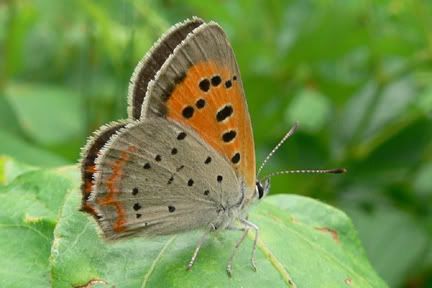
American Copper Lycaena phlaeas
Blues:
Summer Azure Celastrina neglecta/ladon
Eastern Tailed Blue Everes (Cupido) comyntas
Brushfoots:
Great Spangled Fritillary Speyeria cybele
Pearl Crescent Phyciodes tharos
Baltimore Checkerspot Euphydryas phaeton
Buckeye Junonia coenia
Hackberry Emperor Asterocampa celtis
Monarch Danaus plexippus
Little Wood Satyr Megisto cymela
Common Wood Nymph Cercyonis pegala
Appalachian Brown Satyrodes appalachia
Skippers:
Dun Euphyes vestris
Little Glassywing Pompeius verna
Least Ancyloxypha numitor
Mulberry Wing Poanes massasoit
Silver-Spotted Skipper Epargyreus clarus
Wild Indigo Duskywing Erynnis baptisiae
Horace's Duskywing Erynnis horatius
JRC
Read more...