This week, the Black Swallowtails started emerging. There are 17 chrysalises that overwintered in the cage. A male emerged on 5/7 and a female on 5/9. Both were small and had more orange than usual on the underside.
Black Swallowtail Papilio polyxenes ♀
We also found six Cabbage White caterpillars on Yellow Rocket.
Cabbage White Pieris rapae on Yellow Rocket Barbarea vulgaris
And finally, we found 13 American Lady eggs on the Pussytoes in the garden.
American Lady Vanessa virginiensis egg on Pussytoes Antennaria plantaginifolia
The plan had been to leave them on the plant, since the caterpillars make nests that make them harder to raise in cages. However, by the next day, the eggs had been found by ants.
There are two eggs in the picture. The ant was working on the one on the right for at least half an hour, encircling it and working on it with his mouth. Presumably, he was aiming to detach it from the leaf and take it back to the nest.
In any event, we did not want the eggs to go for ant food, so we brought them inside on A. plant. sections that went into pots. The hope is that the plants will root and provide food for the caterpillars.
JRC
Read more...
Tuesday, May 10, 2011
May 7 - 10, 2011: Swallowtails and Ladies

Sunday, March 20, 2011
Coming out of hibernation
The garden is awakening after a cold winter. Daffodils are in bud, hyacinths are emerging. Black-Eyed Susans are showing foliage, as are Pussytoes.
There's Pennsylvania Bittercress aplenty -- we pull that here, along with dandelions.
All of the trees are in bud: Dogwoods, redbuds, maples, spicebushes.
Things seem set for a good year.
JRC
Read more...
Monday, August 2, 2010
Skipper Mystery Solved
Every year at this time, I get one or more of these "little brown thingies." I'd always labeled them as Tawny-Edged Skippers, Polites themistocles.
Trouble is, Crossline Skippers P. origenes can look like this as well. So which is it?
Here were the shots from above, first the male and then the female. 

The evidences in favor of Tawny-Edged were
(1) TEs are usually flat brown on the hindwing below. Crosslines usually have a spot-band around the edge of the disc. Confusingly, TEs may have a hint of spot-band, and Crosslines may not have it.
Example of Crossline(?) with spot-band.
In my case, I was looking at six individuals which uniformly showed no spot-band or maybe the barest hint of one.
(2) TEs are small, the size of Peck's Skipper. Crosslines are larger, the size of Dun Skippers. My individuals were all smallish.
Here's a size comparison:
On the other hand, the following evidences favored Crossline:
(3) Crosslines are the more common of the two.
(4) Crosslines are more likely found in yards and meadows; TEs on the edges of wet meadows.
I posed this question to several knowledgeable folk and got opposite answers. What to do? The answer came in the form of an article by Nick Grishin describing how to differentiate these two species by examining the genitalia of the male.
Quoth my wife: "You have got to be kidding me!"
So: I reverted to my childhood, got a net, and captured two males that were a little worn. They were placed in an ad-hoc killing jar, and their abdomens prepared for examination under the microscope. Here were the results:


With reference to Nick's article, can you make the call?
JRC
Read more...
Monday, July 5, 2010
Carrol Co. 7/4/10
The Carrol Co. butterfly count was a hot, dismal affair. The weather was mid-90s and sunny, and the butterflies were not happy. Notably absent were some typical favorites: Baltimore Checkerspot, Edwards Hairstreak, Appalachian Brown.
We did see these:
Gray Hairstreak Strymon melinus
Banded Hairstreak Satyrium calanus
Eastern Tailed Blue Cupido comyntas
Summer Azure Celastrina ladon
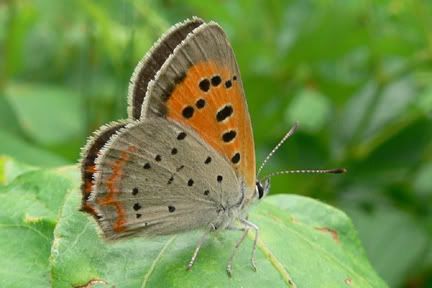
America Copper Lycaena phlaeas
Little Wood Satyr Megisto cymela
Common Wood Nymph Cercyonis pegala
Great Spangled Fritillary Speyeria cybele
Meadow Fritillary Boloria bellona
Pearl Crescent Phyciodes tharos
Viceroy Limenitis archippus
Red-Spotted Purple Limenitis arthemis
Snout Butterfly Libytheana carinenta
Hackberry Emperor Asterocampa celtis
Eastern Tiger Swallowtail Pterourus/Papilio glaucus
Spicebush Swallowtail Pterourus/Papilio troilus
Orange Sulfur Colias eurytheme, including one poor female who was tackled by a Hemiptera species.
Clouded Sulfur Colias philodice
Huge numbers of Cabbage Whites Pieris rapae
Least Skipper Ancyloxypha numitor
Little Glassy Wing Pompeius verna
Silver-Spotted Skipper Epargyreus clarus
Hordes of Wild Indigo Duskywings Erynnis baptisiae
This Orange Sulfur female has a reason for the unnatural pose 
She's being consumed. :(
Three Tiger Swallowtails and an Azure have the right idea...
JRC
Read more...
Saturday, July 3, 2010
Frederick Co. 7/3/10
Hit the powerlines again with the girls. Hot and sunny (mid-80s). We saw
Red-Spotted Purple Limenitis arthemis
Red Admiral Vanessa atalanta
Question Mark Polygonia interrogationis
Mourning Cloak Nymphalis antiopa
Great Spangled Fritillary Speyeria cybele
Eastern Tailed Blue Cupido comyntas
many Azures Celastrina sp.
Orange Sulfur Colias eurytheme
Clouded Sulfur Colias philodice
Cabbage White Pieris rapae
several Spicebush Swallowtails Papilio troilus
Eastern Tiger Swallowtail Papilio/Pterouros glaucus
Wild Indigo Duskywing Erynnis baptisiae
Sachem Atalopedes campestris
Least Skipper Ancyloxypha numitor
JRC
Read more...
Thursday, July 1, 2010
Frederick Co. 6/14/10
Went to the powerline cut-through this day and saw a number of different species and a spectacular mating pair of Great Spangled Fritillaries. Conditions were sunny and 90s.
This pair landed on the grass stems and opened and closed their wings in tandem. It was a sight to behold. The darker-brown female is above.

A Northern Cloudywing Thorbys pylades
A very fresh Gray Hairstreak Strymon melinus
A Crossline Skipper Polites origenes
A male
and a female
An unknown skipper. Dun? Swarthy? 
Another unknown skipper. Crossline? Northern Broken Dash?
Also seen:
American Lady V. virginiensis
Red Admiral V. atalanta
Question Mark P. interrogationis
Eastern Tailed Blue C. comyntas
American Copper L. phlaeas
Eastern Tiger Swallowtail P. glaucus
Spicebush Swallowtail P. troilus
Orange Sulfur C. eurytheme
Cabbage White P. rapae
Little Wood Satyr M. cymela
Least Skipper A. numitor
Notably absent this entire spring: Black Swallowtails (what happened to the thirteen I released fall 2009?!)
JRC
Read more...
Carroll Co. 6/11/10
On a lark, I went out to check the Carroll Co. sites in mid-June. To my surprise, Baltimore Checkerspot season had already begun! Conditions were clear and warm, turning to hazy with sprinkles.
Baltimore Checkerspot Euphydryas phaeton


Also seen were a Little Glassywing Pompeius verna
A Little Wood Satyr Megisto cymela
And an Orange Sulfur Colias eurytheme getting nailed by a Robberfly Asilidae sp.
as well:
Red Admiral V. atalanta
Red-Spotted Purple L. arthemis
Cabbage White P. rapae
Eastern Tailed Blue C. comyntas
Eastern Tiger Swallowtail P. glaucus
Appalachian Brown S. appalachia
Silver-Spotted Skipper E. clarus
Pearl Crescent P. tharos
Spicebush Swallowtail P. troilus
Mourning Cloak N. antiopa
Great Spangled Fritillary S. cybele
Overall a thin count...
JRC
Read more...
American Ladies Vanessa virginiensis
From the "Plant it and they will come" file ...
This spring I decided to plant hostplants for the American Lady. The most common are Pussytoes and Pearly Everlasting, both species of the genus Anaphalis. So I ordered some Pussytoes from Prairie Moon and within weeks, there were little nests containing multiple V. virginiensis caterpillars (discovered 5/31/10).
In fact, the plants were pretty much down to the nub, so it was necessary to quickly find more hostplants. The powerline near us yielded some Pearly Everlasting, along with even more nests. Here's one, with a 2nd or 3rd instar cat. The nests are made by folding up the leaves at the top of the plant with a kind of silk, and the caterpillar eats by scraping off the tops of the leaves while inside the nest. Needless to say, he also poops inside the nest, so everything gets rather messy.
All in all, 10 cats were discovered. Here are four of them in various stages:
The setup seen here, several plants in a Glad container with water, works well for Monarchs, but not so well for these -- there's not quite enough foliage to form a nest, perhaps?
A 5th instar cat
By 6/11/10, the cats began to pupate

and on 6/20/10 we got our first Lady!
Overall, the results were poor. Four cats died. One pupated near the cage zipper and got caught by mistake. One chrysalis failed to eclose. Four hatched successfully. The hope is that next year, when the Pussytoes are stronger and more leafy, we can bring more cats to adulthood.
JRC
Read more...
Saturday, May 15, 2010
Red Admiral Explosion
The last three days have seen the emergence of a huge brood of Red Admirals Vanessa atalanta. We went for a butterfly walk today and saw approximately 75 individuals, along with...
Red Admiral Vanessa atalanta

Tawny-Edged Skipper Polites themistocles
Horace's Skipper Erynnis horatius
Red-Tailed Hawk Buteo jamaicensis
JRC
Read more...
Thursday, May 6, 2010
Soldier's Delight 5/5/10
Soldier's Delight is a state park in Baltimore Co., MD. Its geology is unusual in that its rock formations are primarily serpentine, resulting in unusual flora, resulting in unusual fauna.
The big finds at Soldier's Delight are Falcate Orangetips and Elfins. Unfortunately I saw none of these, although a posted sign in the visitor's center announced that FOs had been seen on the butterfly walk of 5/2/10. The Orangetip hostplant, Lyre-Leaved Rockcress, was everywhere.
The other local specialty was out in force, however: Cobweb Skippers.
Cobweb Skipper Hesperia metea -- 
All in all, there were about 15 of these, including a female being chased by a quite amorous male. In the end, he chased her up my camera strap!

There were also several duskywings, including at least one Horace's:
Horace's Duskywing Erynnis horatius -- Duskywings are a pain to identify, but the short, naked palps (mouth parts) on this individual are convincing evidence that this is neither a Dreamy nor Sleepy Duskywing. *sigh* 
Several Swallowtails were out: a Tiger and two Spicebush.
Eastern Tiger Swallowtail Pterourus glaucus (older references have Papilio glaucus)
Also seen: two Orange Sulfurs Colias eurytheme, c. 20 Pearl Crescents Phyciodes tharos (many in a strongly marked spring form), and an American Lady Vanessa virginiensis.
JRC
Read more...
Tuesday, April 13, 2010
Myrtle Beach 4/10/10
The annual pilgrimage to Huntington State Park yielded a couple of surprises.
First was a walk through the Sandpiper trail. As usual, the colony of Juniper Hairstreaks stayed well to the tops of redcedars.
But new this year were Henry's Elfin Callophrys henrici. I thought they were Brown Elfins, but the pics are convincing...
This individual nectared for a while on this plant of unknown identity. It has dark blue berries with a single large seed inside (an olive, perhaps?)
Around 4PM, two individuals were hanging out on some bushes with blueberry-like leaves and red berries. The lighting was unfortunate.
Update: is that egg-laying going on?


Second, the park has a powerline cut-through right near US 17. This cut-through is prime butterfly territory, awash in dewberries as a nectar source. I did see some poison ivy just emerging, though...
There were a large number of duskywings about. Some were relatively well-marked and large; others were less marked and noticeably small. I suspect that the majority are Horace's Duskywing (Erynnis horatius) with a couple of Juvenal's Duskywings (Erynnis juvenalis) thrown in. Let the reader decide!
A very frosted individual who would not pose properly...

Look, ma! No hindwing spots! The lack of spots is diagnostic for E. horatius.

There were also a large number of Silver-spotted Skippers Epargyreus clarus
In contrast to June behavior, these refused absolutely to pose for photos.
Of note was a small flock of American Ladies Vanessa virginiensis. These individuals were the smallest I've seen, easily 2/3 normal size or less. For comparison, these are sitting on dewberry flowers.

Also seen but not pictured: Black or Spicebush Swallowtail on the wing.
JRC
Read more...